Are reusable nappies actually better?
Reusable nappies produce less carbon and far less waste, but the advantage is smaller and more conditional than it first appears. Cost, washing and parental time make the trade-off much messier than “reusable good, disposable bad”.
My sister recently suggested I look into nappies. She has a young daughter and has been experimenting with elimination communication, which is essentially helping babies use a potty long before they would conventionally be considered “potty trained”. She also wondered how cloth nappies compare with disposables on cost, environmental impact and sheer parental effort.
I should say upfront that I do not have children, and this is emphatically not a post about how parents ought to raise theirs. Parenthood seems exhausting in ways I can only partly appreciate. Whether a family uses disposable nappies, cloth nappies, elimination communication or some mixture of the three seems exactly the kind of decision where convenience matters enormously. I was mostly interested in whether the environmental story is as simple as it looks. It isn’t.
Cloth is lower-carbon, but not dramatically so
Before looking into this, I would have assumed reusable nappies were overwhelmingly better for the environment. One gets washed and used again. The other gets used once and thrown away. The physical waste difference really is enormous. But waste is not the same thing as total environmental impact.
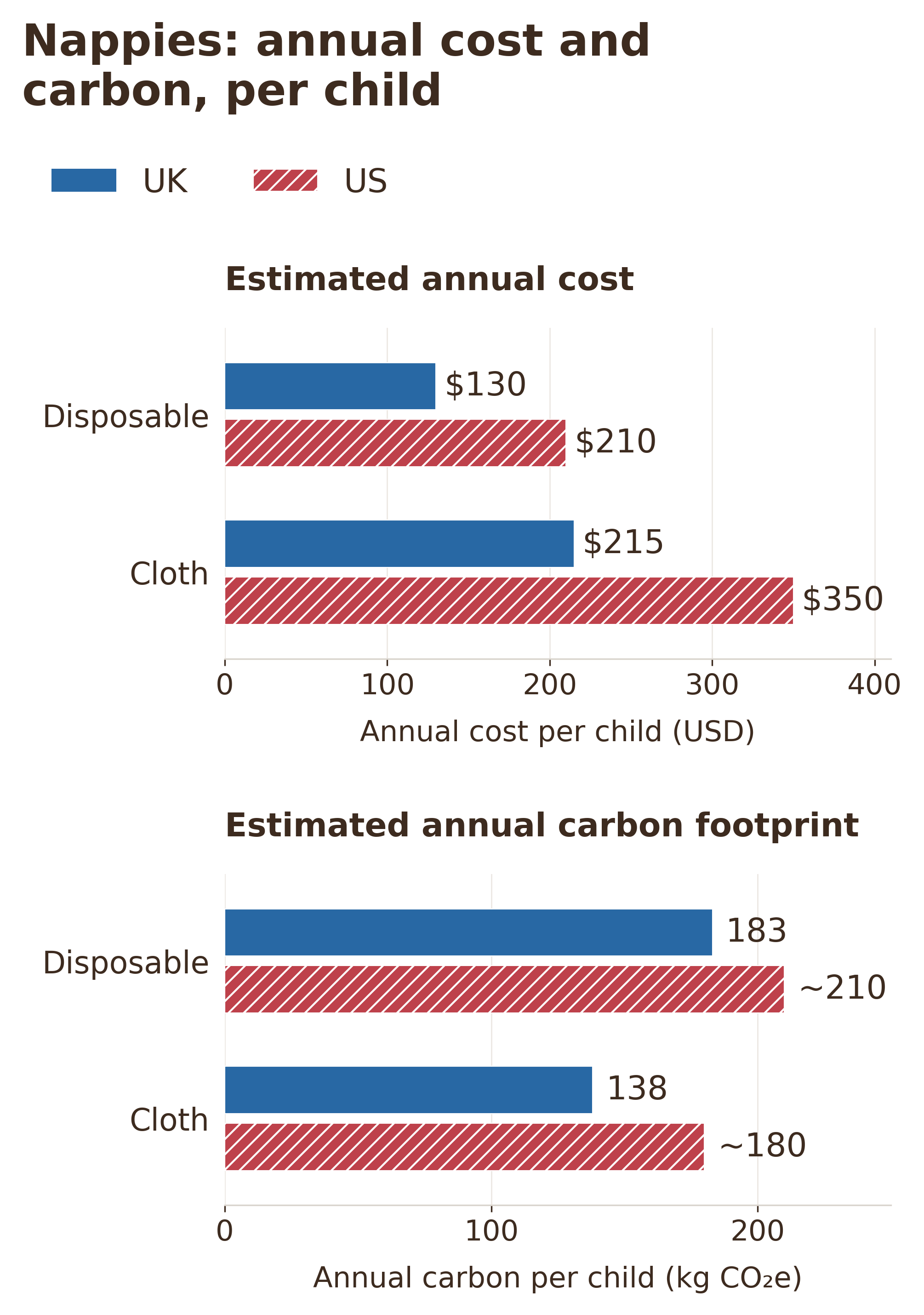
The best modern comparison I found is Defra’s 2023 UK life-cycle assessment. It estimated roughly 457kg CO₂e from disposable nappies over the first two and a half years of a child’s life, versus about 345kg from reusable nappies. Annualised, that is around 183kg for disposables and 138kg for cloth. So reusable nappies come out about 25% lower-carbon under the assumptions in the study. That is meaningful. It is also much smaller than I would have guessed from looking at the two products.
The reason is laundry. Reusable nappies have to be manufactured too, then washed and dried again and again. Their impact depends heavily on washing temperature, machine efficiency, tumble drying and whether the nappies are reused for another child. That is why I would describe cloth as “lower-carbon”, not simply “greener”. Defra itself did not find one nappy type clearly superior across every environmental category.
One detail worth making explicit is that the life-cycle analysis already includes methane produced when biodegradable material in disposable nappies decomposes in landfill. Its end-of-life modelling includes landfill-gas capture, flaring and uncaptured methane, so there is no extra landfill-methane penalty to add on top of the headline CO₂e figure.
The waste mix is also a snapshot in time. The Defra analysis assumed a larger share of disposable nappy waste going to landfill than England sends there today. As landfill has declined and incineration has increased, the methane component of the current footprint may be lower. Incineration is not emissions-free, however: burning the plastic components produces fossil CO₂. So this is a change in the form and balance of end-of-life emissions, not an equivalent reduction in total climate impact.
And the carbon numbers are small in the grand scheme of things
There is another denominator worth adding. The average British consumption footprint is roughly 10 tonnes of CO₂-equivalent per person per year. Disposable nappies for one child, at about 183kg a year, therefore amount to roughly 1.8% of one average person’s annual footprint. Reusable nappies are about 1.4%. So switching from disposable to cloth saves roughly 45kg CO₂e a year, or less than half a percentage point of one average Briton’s annual consumption footprint.
The US comparison is less exact because the underlying carbon datasets are not perfectly comparable, but the broad picture is similar or smaller because the average American footprint is higher.
That changed my reaction to the whole debate. A 25% reduction sounds large if the denominator is “emissions from nappies”. It sounds much less dramatic if the denominator is “everything one person consumes in a year”. Nappies matter. They are not one of the dominant climate decisions a household makes.
The cost story is less obvious than I expected too
Reusable nappies are often sold partly on the claim that they save money. That can be true. If you compare cloth with premium disposable brands, reuse the same cloth nappies for another child, or buy them second-hand, the savings can be substantial. But if you compare with the cheapest widely available disposables, the result can reverse.
Using budget supermarket pricing, the annual cost of disposable nappies in Britain can be surprisingly low. Our rough estimate for the cheapest mainstream option was about £100 a year, versus roughly £160 for cloth once the purchase and washing costs are spread across the nappy period. For the chart above, I converted the estimates into dollars so the UK and US figures could share a single axis. For the US, the equivalent rough comparison was around $210 for cheap disposables versus perhaps $350 for cloth.
Those are not national averages. Prices vary enormously, and cloth systems range from cheap second-hand bundles to expensive all-in-ones. But the broad point is that cloth is not automatically cheaper. Against premium nappies, probably yes. Against Aldi-level nappies for one child, not necessarily.
What about all that rubbish?
The most visually obvious case against disposables is the bin. Britain throws away an estimated 3.6 billion disposable nappies a year. Local authorities are estimated to spend more than £140 million a year dealing with nappy waste. In the US, disposable nappies and adult incontinence products together generated about 4.1 million tons of municipal waste in 2018, around 1.4% of the total municipal waste stream. Those are big piles.
But I think the standard argument often identifies the wrong problem. The issue is not that Britain or America is about to run out of physical landfill space. Landfill causes real local planning, transport and pollution problems, but sheer national land availability is not the binding environmental constraint people sometimes imagine. And in Britain, increasing amounts of residual waste are incinerated rather than buried anyway.
The stronger criticism is material. A disposable nappy turns pulp, plastics and super-absorbent polymers into a mixed, contaminated product that is used once and then is extremely difficult to recover. In the US EPA’s figures, essentially none of that material was recycled or composted. So the waste argument is real, but slightly different from the usual mental image. Reusable nappies dramatically reduce residual waste. That does not mean landfill itself is an existential crisis.
The missing environmental input is the parent
There is another thing life-cycle assessments struggle to capture: time. Disposable nappies outsource work. A factory makes the product. A parent uses it once. The waste system takes it away.
Reusable nappies move some of that labour back into the household. They must be stored, washed, dried, sorted and prepared for use again. That time is not free merely because it does not appear on a receipt.
There is surprisingly little good research measuring exactly how many additional minutes cloth nappies consume. A rough illustrative estimate might be two to four extra laundry loads a week and perhaps 30 to 80 minutes of active handling. Over two and a half years, that could mean something like 65 to 170 hours. Treat that as an illustrative estimate, not a research result.
But it helps explain why the financial comparison matters less than it first appears. Suppose cloth saves £300 over the entire nappy period but requires another 100 hours of parental work. That is effectively £3 saved for each additional hour. Against premium disposables the arithmetic may look much better. Against the cheapest supermarket nappies, there may be no financial return at all.
And there is an obvious distributional issue underneath this. Domestic work is not shared perfectly. Recommendations that move dozens or hundreds of hours of labour into the home should at least acknowledge whose time is likely to absorb it. Convenience is not a moral failure. It is one of the things disposable nappies are selling.
There is a third option hiding in the debate
This was the part I found most interesting. Almost every comparison asks whether the child should wear a reusable nappy or a disposable one. But another way to reduce the environmental impact is simply to use fewer nappies. Within the nappy question, duration may matter as much as material. That sounds obvious, except that the age at which children stop using nappies varies enormously between cultures.
One striking study followed 47 Vietnamese children and compared them with 57 Swedish children. Among the Vietnamese children, 89% were already being offered a potty every day by six months. By two years, potty training was complete for 98%. Among the Swedish children, only 5% had even started daily potty training by two.
The process in Vietnam was not the same thing as asking a six-month-old to independently use the toilet. Parents watched the child’s timing and cues, offered the potty and sometimes used a consistent whistling sound. In Western parenting circles, this is usually called elimination communication or assisted infant toilet training.
That makes the environmental comparison more interesting. A family can reduce nappy impacts by choosing a lower-carbon nappy. Or it can reduce them by shortening the period during which nappies are needed. Those are different interventions.
And the second one raises a much larger historical question: why do children in Britain and America now stay in nappies so much longer than they used to? I ended up finding that question more interesting than the cloth-versus-disposable one. That is the next post.