The cake flour Britain won’t let me buy
Chlorinated cake flour sounds alarming. The evidence says it is safe at regulated levels. I think Britons should be allowed to buy it.
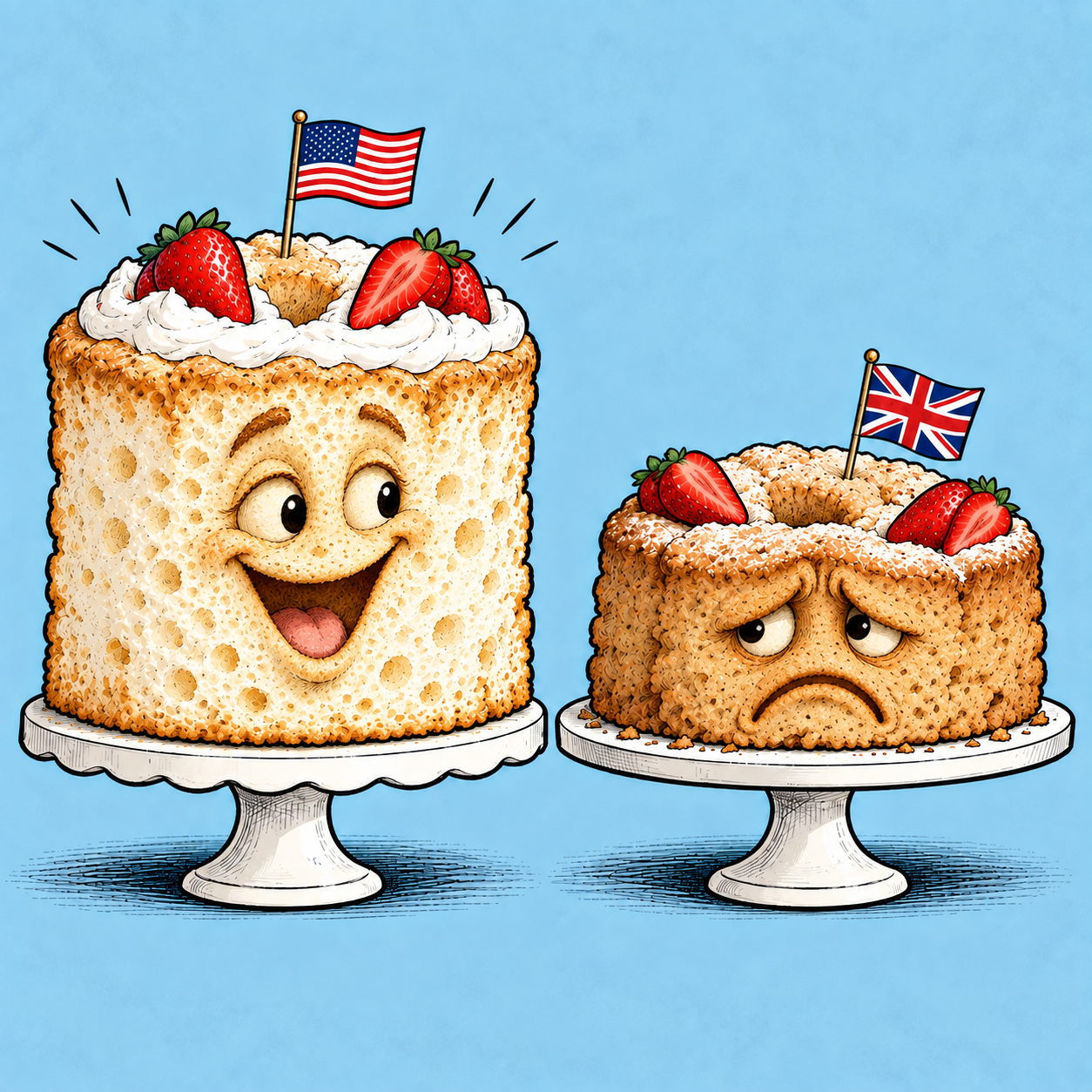
My grandma used to make angel food cake when I was a kid. It was light, almost impossibly fluffy, usually topped with strawberries, and I loved it.
Recently I tried to recreate it in London. The cake was good. I didn’t have quite the right tin, and my technique probably wasn’t identical to my grandma’s, but there was another difference I hadn’t anticipated: I couldn’t buy the same flour.
I mentioned this to my dad, who is a flour miller. He pointed out that American cake flour is often chlorinated. British flour isn’t.
“Chlorinated flour” sounds terrible. It conjures up bleach, swimming pools and industrial chemicals, none of which I particularly want in my grandma’s angel food cake.
But the more I looked into it, the stranger the British rule seemed.
This post is only about flour. There are much broader and more complicated differences between British and American food regulation, farming and animal welfare, which I may come back to separately. Chlorinated flour turns out to be an unusually neat case.
Why would anyone chlorinate flour?
Cake flour is already different from ordinary flour. It is generally made from soft wheat and contains less protein, which means less gluten and a more tender cake.
But traditional American cake flour has another trick. Millers expose the flour to a controlled amount of chlorine gas.
This does bleach the flour, but whitening it isn’t the important part for cake-making. Chlorination changes the behaviour of the flour’s starches and proteins. In particular, it changes how the starch behaves as a cake heats up, helping the batter set into a stable structure rather than collapsing. The effect is particularly valuable in cakes containing a lot of sugar and liquid. (Review of chlorine’s role in high-ratio cake flour)
This isn’t just baking folklore. Experiments with angel food cake specifically have found meaningful differences in crumb structure and other physical characteristics when chlorinated flour is used. That does not mean it invariably makes a bigger or better cake: in that study, chlorination produced a more even, stable structure but reduced volume and tenderness.
You can approximate American cake flour in Britain by replacing some plain flour with cornflour. That reduces the effective protein content. But it doesn’t reproduce the chemical changes caused by chlorination. Low-protein flour and chlorinated flour are not the same thing. More elaborate formulations can nevertheless produce comparable cakes without chlorination.
This helps explain why my London angel food cake could be perfectly good without being quite the cake I remembered.
Is eating it dangerous?
This was the part I expected to make Britain’s position easy to understand.
It didn’t.
The Joint FAO/WHO Expert Committee on Food Additives, or JECFA, has evaluated chlorine as a flour-treatment agent and established an acceptable treatment level for cake flour of up to 2.5 g/kg. That evaluation dates from 1985.
Codex Alimentarius, the international food-standards system run by the FAO and WHO, provides for the same maximum treatment level, 2.5 g/kg, specifically for flour used in high-ratio cakes.
Importantly, that is a treatment level, not a claim that the finished flour contains 2.5 g/kg of residual chlorine. It describes how much chlorine is applied to the flour, where it reacts with the flour’s constituents. (JECFA toxicological evaluation)
There have also been long-term feeding studies. In one study published in 1983, rats ate diets in which cake made from untreated flour or flour treated with chlorine at up to that same 2.5 g/kg level constituted 79% of their diet for two years. Researchers reported no treatment-related differences in health, behaviour or mortality.
That doesn’t mean science has demonstrated that chlorinated flour has literally zero risk. Science rarely establishes that about anything.
There is also a legitimate historical wrinkle. European scientific advisers reviewing the evidence in 1990 noted deficiencies in some animal studies and insufficient information about exactly which reaction products are formed when chlorine reacts with flour. They found no clear evidence of toxicity, but did not consider the evidence adequate to establish safety and called for further work. That is a real difference in regulatory judgement, not simply a fear of the word “chlorine”.
But this isn’t a substance that international food-safety authorities examined and concluded was too dangerous to eat. JECFA established an acceptable treatment level, and Codex provides for this cake-flour use. Codex is an international standard, not a permission that overrides national law.
Britain takes the choice away
Britain’s rule is straightforward. Government guidance says:
“Flour bleaching agents are not allowed as an ingredient in the preparation of flour or bread.”
It explicitly gives chlorine as an example.
The prohibition covers flour milled in the UK or imported for sale on the British market, as the current government guidance explains. Commercially importing American chlorinated cake flour is therefore not a lawful workaround.
Nor is this an American technique Britain never adopted. The 1963 Bread and Flour Regulations, regulation 30(2)(c) explicitly permitted chlorine in non-wholemeal flour intended for cakes. Britain once allowed it, then prohibited it.
I haven’t found a substantial modern campaign among bakers, millers, consumers or politicians to restore it. The parliamentary intervention I did find went the other way: Baroness Bennett asked in 2023 about keeping prohibited flour additives out. The government replied that the bleaching-agent ban was outside the retained-EU-law review.
America takes a different approach in this case. Chlorine treatment is permitted, and both treated and unchlorinated cake flours are available. The FDA lists chlorine as a permitted bleaching ingredient under federal flour standards, in a quantity no greater than needed for its bleaching and artificial-ageing effects.
That distinction matters to me.
There are plenty of situations where “just let consumers choose” is an inadequate philosophy of food regulation. Consumers cannot test their dinner for carcinogens. Antibiotic use in livestock can create antimicrobial resistance affecting people too. Agricultural practices can impose environmental and animal-welfare costs on people and animals who aren’t parties to the transaction.
Chlorinated cake flour is much harder to fit into that argument.
It has a useful technological function. International food-safety authorities have assessed its use as acceptable at specified levels. Consumers who don’t want it can buy unchlorinated flour. And I can’t identify a meaningful external cost created by letting me buy it.
Under those circumstances, I think the presumption should be freedom to choose.
If there is demand for chlorinated cake flour and a mill wants to make it, why should the government prevent the transaction?
Neither approach is unusual
It would be easy to turn this into another story about America’s permissive approach to food regulation versus Europe’s precautionary one. The international picture is messier.
Canada, like the US, explicitly permits chlorine as a flour-treatment agent. And Codex, the international standard, provides for chlorine treatment specifically for high-ratio cake flour at up to 2.5 g/kg.
Britain isn’t alone either. Chlorine is not authorised for this use in the EU’s permitted food-additive framework.
Japan’s official food-import guidance lists chlorine dioxide as a wheat-flour treatment agent. That is a different compound from chlorine gas, so it should not be treated as the same permission.
So neither the US nor Britain stands alone. Different regulatory systems have reached different answers.
What I find striking is that the international food standard explicitly accepts the treatment. Britain nevertheless prohibits it.
A small case for letting people choose
None of this matters very much in the grand scheme of food policy.
I can make angel food cake in London. It can be very good. There are workarounds, and nobody is suffering because British supermarkets don’t stock American-style chlorinated cake flour.
But perhaps that’s exactly why I find the rule interesting.
“Chlorinated flour” sounds like precisely the sort of thing a sensible food regulator ought to keep away from consumers. Once you get past the name, though, the case becomes much less obvious. There is a reason bakers use it. Its effects are useful. International food-safety authorities consider it acceptable at regulated treatment levels. Americans and Canadians can buy it. People who would rather avoid it can buy unchlorinated flour instead.
Britons don’t get that choice.
My preference in a case like this is fairly simple: demonstrate a meaningful risk or external cost, and regulate it accordingly. Otherwise, let people decide what cake flour they want to buy.
That principle certainly won’t resolve every disagreement between American and British food regulation. I suspect many of the more interesting cases will be much harder.
But for now, I’d just like to make my grandma’s angel food cake with the flour it was designed for.
Drafting and source checking were aided by ChatGPT Astra.