The Honest Price of a Flight
If airline offsets do not work, the next-best move is to treat the ticket price as artificially cheap and budget for climate advocacy on top.
Part 2 of 2
For the past two years I have been offsetting my flights through Cool Effect, a platform that curates what it claims are higher-quality carbon projects than the typical airline checkbox. I felt fine about it. It seemed better than nothing, better than the £2 option at checkout, with some verification behind the projects.
Writing the first part of this series changed my mind. The more I looked at how the voluntary carbon market actually works, the less confident I became that even the better-quality offsetting platforms are doing what I hoped. The additionality problems, the permanence risks, the moral licensing effect, and above all the universalizability failure: none of these go away because the project has a nicer website and a third-party certification.
So I am rethinking it. What follows is where I have landed, with the caveat that I am still working this out rather than presenting a finished system.
What Is Actually Worth Your Money?
The most cost-effective climate interventions are not individual acts of carbon removal. They are policy and advocacy organisations that shift entire regulatory frameworks, and the leverage they provide is extraordinary.
Clean Air Task Force is the clearest example. Founders Pledge, which rigorously evaluates climate charities, estimates that a donation to CATF averts one tonne of CO2 equivalent for somewhere between $0.10 and $1. That is not a typo. By funding technical policy work on hard-to-abate sectors including aviation, methane emissions, and nuclear energy, a relatively small amount of money influences legislation that affects billions of tonnes of emissions. A donation of $100 to CATF has, on reasonable estimates, 100 to 1,000 times the climate impact of $100 spent on forestry credits.
Giving Green, which independently evaluates climate charities annually, has consistently listed CATF among its top recommendations. Carbon180 focuses specifically on carbon removal policy, complementing CATF’s emissions reduction work. The International Council on Clean Transportation does rigorous technical work on sustainable aviation fuel standards and airline accountability, directly relevant if your concern is specifically flying.
If you want to go further and contribute to permanent carbon removal technology, not as an offset but as a technology investment, Charm Industrial accepts individual purchases. They convert agricultural waste into bio-oil and pump it underground. The price reflects the real cost: around $600 per tonne. One real tonne is more useful than a hundred fake ones.
The Honest Price of a Flight
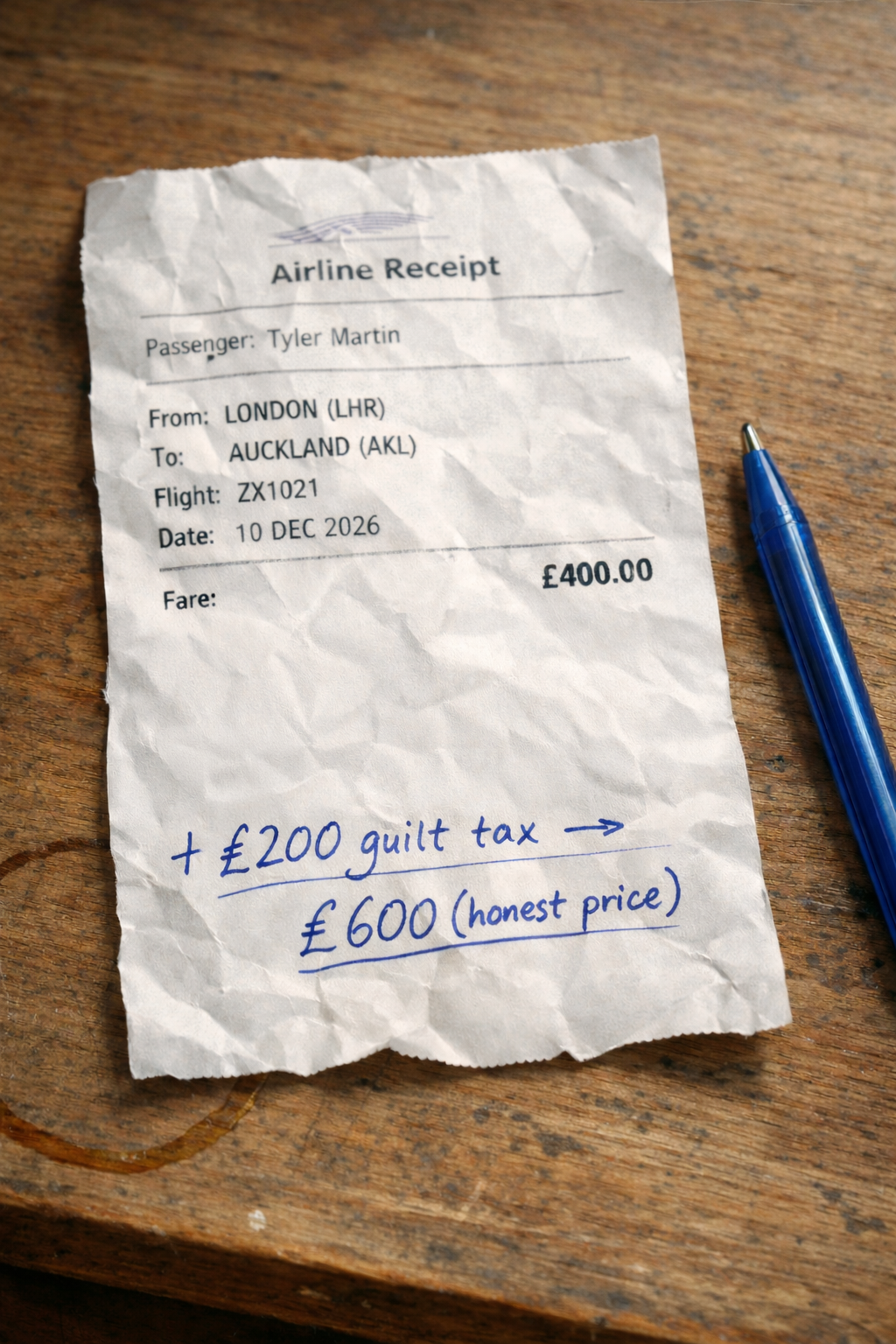
The ticket price is not the price of the flight. The ticket price is what the airline charges you to get on the plane. The actual cost, including the externality imposed on the atmosphere and transitively on everyone who lives in it, is higher. The question is how to make that visible at the moment you are deciding.
My current answer, which I am trying out rather than confident in, is 1.2x. If the ticket costs £500, I treat the trip as costing £600 and direct the extra £100 to effective climate advocacy. It is not a carbon offset. It does not make the flight neutral. It is an acknowledgement that the ticket price is subsidised by an atmosphere that has not sent an invoice.
I want to be direct about something. I am in a fortunate position: I have the disposable income to absorb an extra 20% on a flight budget, and enough flexibility in work and life to take the trips in the first place. Not everyone has either. This kind of individual financial commitment is only available to people operating well above the margin, and framing it as a general solution would be dishonest. It is what I can do. It is not what most people can do, and the aviation problem does not get solved by a small minority paying slightly more to fly.
With that said: the psychology of the 1.2x anchor matters. Pre-commitment works. Making the decision at the point of booking, before the trip is mentally finalised, is far more effective than intending to donate later. Including the full 1.2x cost in your travel budget also means you are pricing trips more honestly when deciding whether to take them. A flight that looks affordable at £500 looks slightly less reflexive at £600. That friction is a feature, not a bug.
Why 1.2x and not 2x? Because 2x would breed resentment, and a commitment you abandon after two trips is worse than a smaller one you keep indefinitely. The right multiplier is the highest one you will actually maintain.
On footprint tracking apps: Giki Zero, Capture, and Pawprint are all worth using for baseline awareness. But treat their aviation figures as a floor: most calculate against CO2 alone without a radiative forcing multiplier, which means they understate your flight footprint by a factor of two to three.
The Honest Conclusion
I will keep flying to see my friends and family in the US and New Zealand. I will keep travelling solo, and with my wife, and with people I want to spend time with in places that are worth going to. That is not a moral failing I intend to resolve. It is a consequence of living a full life in a world where the people and places that matter are not all in the same postcode.
What I will not do is pretend the externality doesn’t exist, or pay the price of a large coffee to make it disappear.
The 1.5x rule is not a solution to aviation emissions. Nothing an individual does is a solution to aviation emissions. That requires policy, technology, and systemic change. But it is an honest accounting. It keeps the real cost visible every time I book. It directs money to work that can actually move the needle. And it resists the comfortable fiction that the problem has been solved at checkout.
The honest price of a flight is higher than the airline charges. Acting like it is, consistently and without expecting absolution, is about as much as I know how to do.