The Monks Were Tracking Climate Change All Along
Kyoto's cherry blossom record turns a thousand years of hanami diaries into a climate dataset, and the modern bloom dates now move with warming March temperatures.
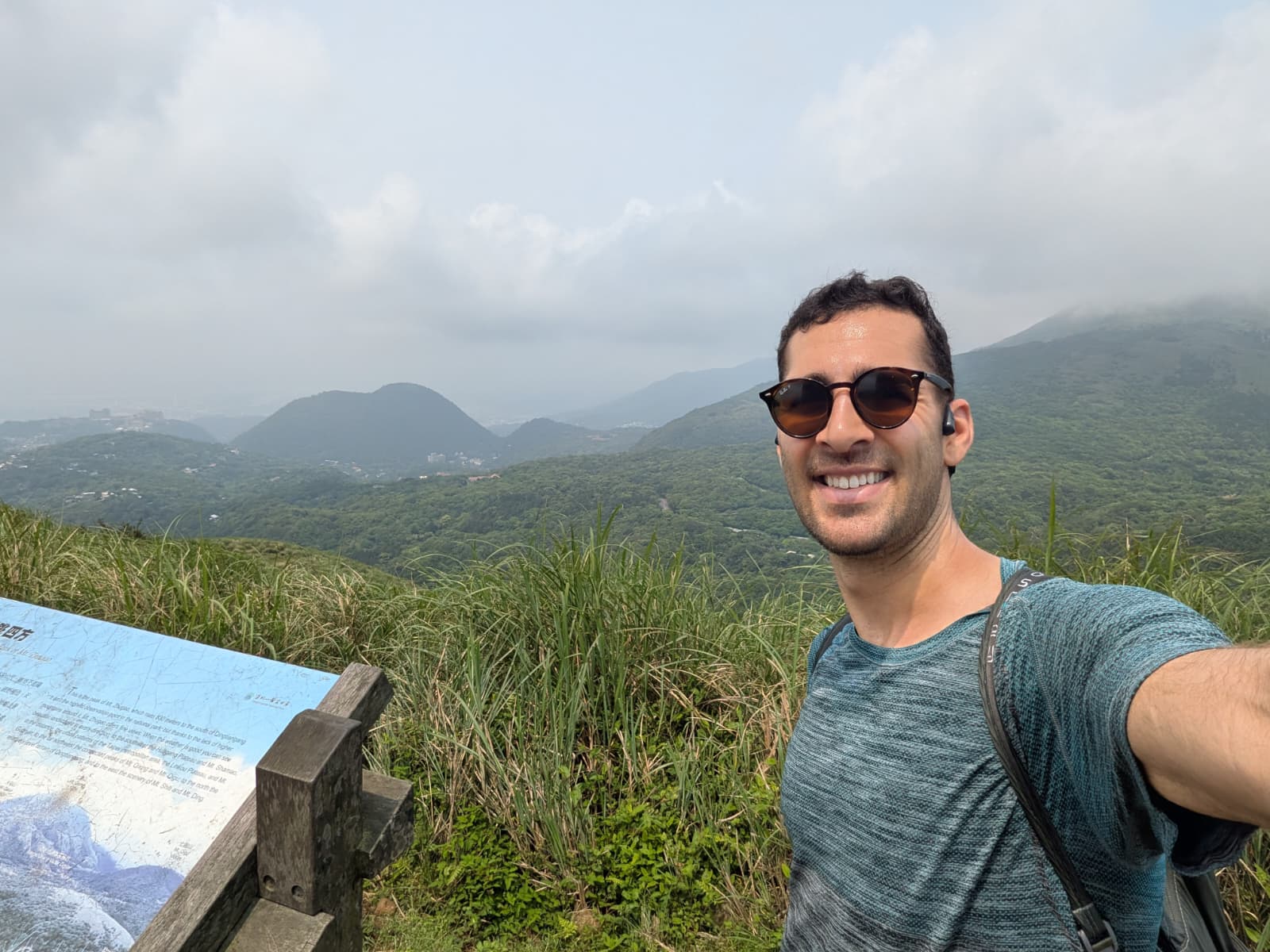
I’m writing this from Taipei, two days into a trip I planned partly around the weather. Not a specific event, no festival, no bloom window, just the fact that April in Taiwan sits in a narrow band of pleasant before the humidity arrives and makes everything feel like standing inside someone’s mouth. It worked. It’s 24 degrees and clear and I’ve already eaten more dim sum than I can justify.
I noticed it almost immediately. I’d read that Taipei had plum blossoms earlier in the year and half expected to catch the tail end of it. But by April they’re long gone. Plum blossom season here peaks in January and February, mostly up in places like Yangmingshan National Park, and there wasn’t a trace of it left.
What there is instead is green. Everything is green. The parks, the hills that ring the city, even the gaps between buildings feel overgrown in a way that’s hard to get in Europe. It’s not a moment in the calendar so much as a state the place sits in. Warm, humid, and quietly thriving.
It’s a different kind of seasonality. Less legible, less optimised for visitors, but more forgiving. You don’t feel like you’ve missed something. You just arrived at a different version of it.
The tourism problem nobody’s talking about
Every spring, millions of travellers time flights, book ryokans, and schedule days off work around cherry blossom season in Japan. Kyoto alone sees something close to a pilgrimage. Maruyama Park, the canal at Keage, the hills around Arashiyama. The tourist infrastructure has been calibrated around it for decades. Hotels surge. Buses overflow. Instagram turns pink.
The problem is that the cultural calendar is fixed and the trees are not.
Festival dates, package tours, and school holidays are set months in advance. The bloom is a biological event tuned to temperature, and the temperatures are changing. In recent years, cherry blossom in Kyoto has peaked a week or more earlier than historical averages. The ryokan you booked for “peak bloom week” might be full of bare branches, while the actual bloom happened quietly the week before.
1,200 years of a single obsession
What makes this measurable is unusually good data.
Yasuyuki Aono, a researcher at Osaka Prefecture University, assembled a dataset of cherry blossom peak bloom dates in Kyoto stretching back to 812 AD. The early data comes from diaries and chronicles of emperors, aristocrats, monks, and governors who recorded hanami dates with surprising care. They weren’t doing science. They were documenting something culturally important. In doing so they created one of the longest continuous phenological records on earth.
From around 1880 onward, observed meteorological records from the Japan Meteorological Agency take over, giving a clean modern series. The two halves stitch together well. And what they show is hard to ignore.
What the data shows
The chart below plots peak bloom dates and March mean temperatures in Kyoto in 5-year periods from 1950 to 2024. The code and full public repo are on GitHub.
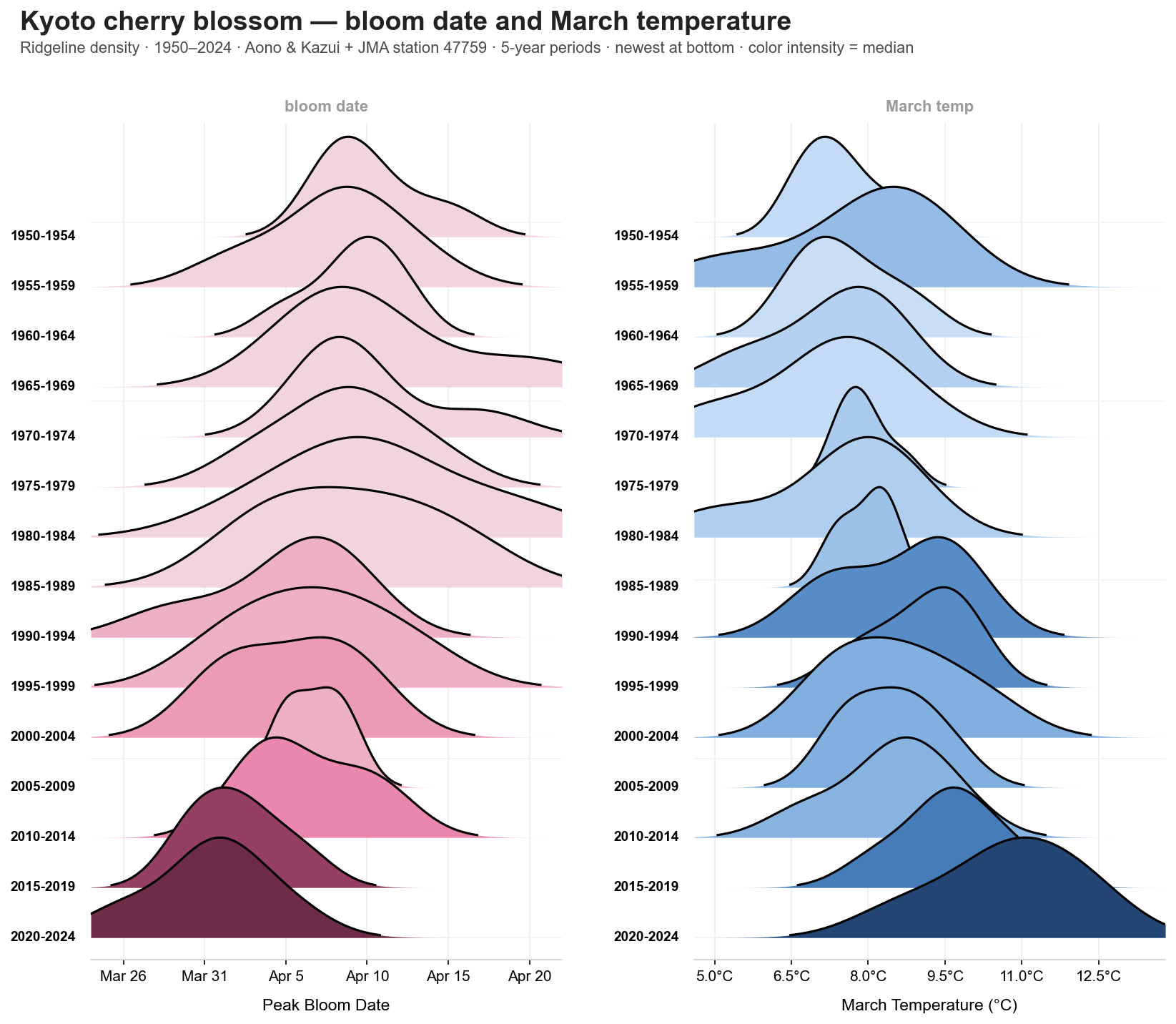
The 1950s and 1960s sit centred around early April, roughly April 9 or 10, with real variability but a stable midpoint. From the 1980s onward, the distribution compresses and shifts earlier. By the 2010s, the median is around April 3 to 4. In 2021, peak bloom came on March 26, the earliest in over 1,200 years.
The temperature data tells the same story in reverse. March in Kyoto has warmed from around 7 to 8°C in the mid 20th century to closer to 10 to 11°C today. That roughly 2.5°C increase maps almost linearly onto earlier bloom. Each degree of warming shifts peak bloom roughly five to six days earlier. Across the full dataset, the correlation between March temperature and bloom date is about -0.83.
There is noise. The 1970s show a brief cooling and a corresponding pause. But the direction since 1980 is consistent.
Globally, average surface temperatures have risen by about 1.1°C since pre-industrial levels. Japan has warmed faster than that, roughly 1.2 to 1.4 times the global rate, and Kyoto amplifies it further through urban heat island effects. Under mid-range emissions scenarios, models suggest another 2 to 3°C of warming by 2100, which would push typical bloom into mid to late March.
What this means in practice
This is not really a guide for when to go to Japan. If anything, a perfectly predictable bloom season would be ideal. Not so you can catch it, but so you can reliably avoid it.
Right now you get the worst of both worlds. A huge amount of demand compressed into a moving target. People book around a historical average that no longer holds, and the result is overcrowding in the wrong weeks and disappointment in the right ones.
There is something appealing about the opposite setup. A place without a single telegenic seasonal peak, where there is no obvious “correct” week to visit, and therefore less pressure on any given one. Taiwan feels closer to that. You are not trying to hit a moment. You are just showing up.
I also realised, slightly sheepishly, that I did not come to Japan on this trip despite what feels like everyone I know in London having gone recently and come back with a kind of cult-like enthusiasm about it. This was partly accidental and partly deliberate. There is a version of travel that revolves around synchronising yourself to a narrow window. And there is a version that does not.
A closing note
The monks who recorded hanami dates in the ninth century weren’t thinking about climate. They were observing something beautiful and writing it down, year after year.
Over a thousand years later, that habit of observation turns out to be one of the most valuable climate datasets we have. A 1,200-year proxy for March temperatures in central Japan, assembled without scientific intent.
The data is there. Whether the festivals, booking systems, and tourist infrastructure catch up to it is a different question.
For now, I’m making the most of the warmth, sunshine, and greenery, and will no doubt return home evangelising my friends.