The Problem With Carbon Offsets
Why airline offsets fail on additionality, permanence, and scale, and why one long-haul trip home is not a rounding error.
Part 1 of 2
I have friends and family in the United States and New Zealand. I live in London. I love to travel, both solo and with my wife and friends. I also take my carbon footprint seriously enough that it creates a low-grade cognitive dissonance every time I open a flight booking site.
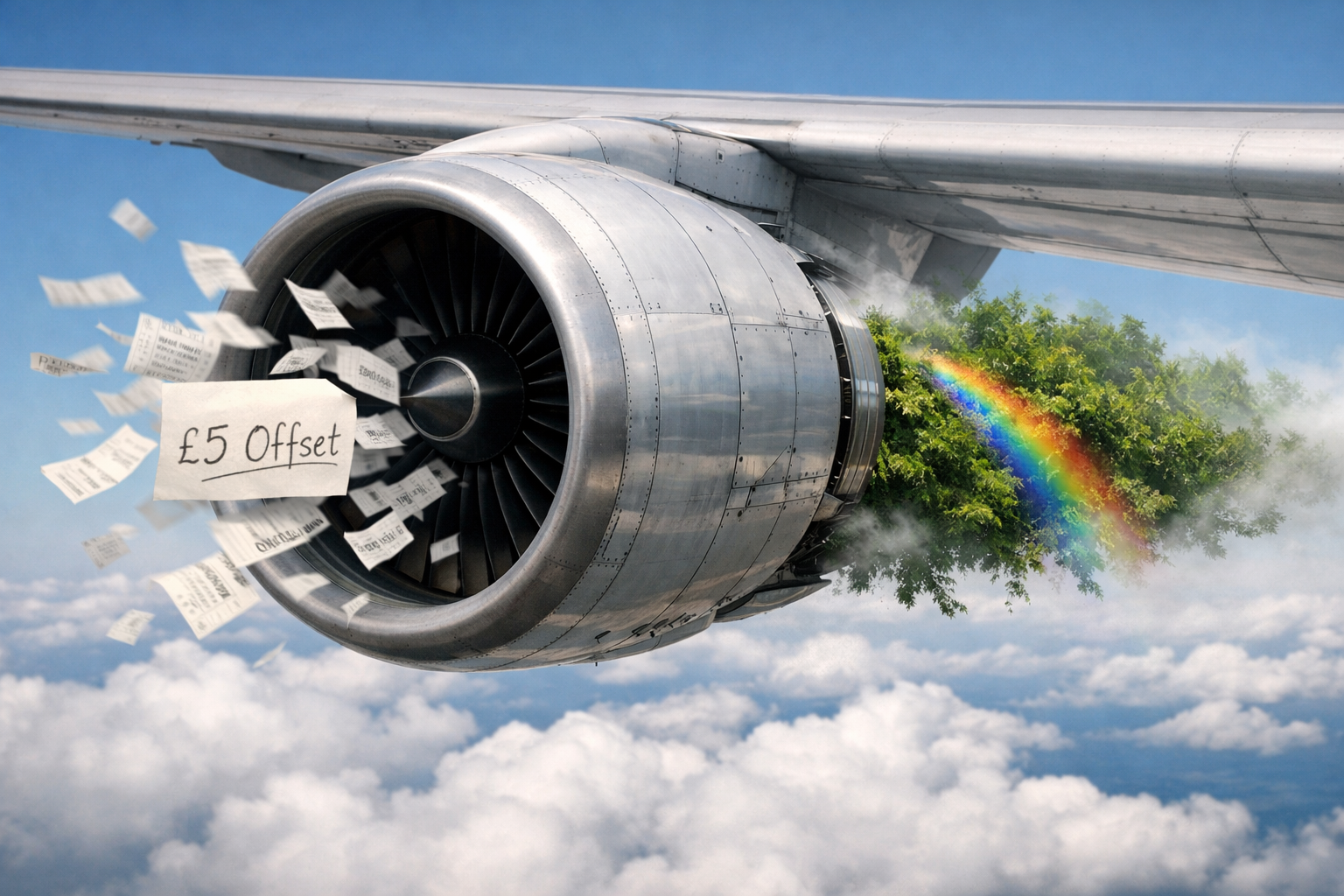
I am not going to stop visiting the people I love. I am not going to pretend that the flights don’t matter. What I want is to think clearly about what those flights actually cost, and what I can do about it that isn’t self-deception.
What Flying Actually Costs the Atmosphere
The average UK resident has an annual carbon footprint of roughly 10 tonnes of CO2 equivalent, using a consumption-based accounting method that includes emissions embedded in imported goods and food. The government prefers a narrower figure of around 4.5 tonnes, but that excludes aviation, shipping, and the carbon embedded in imports. The 10-tonne number is more complete.
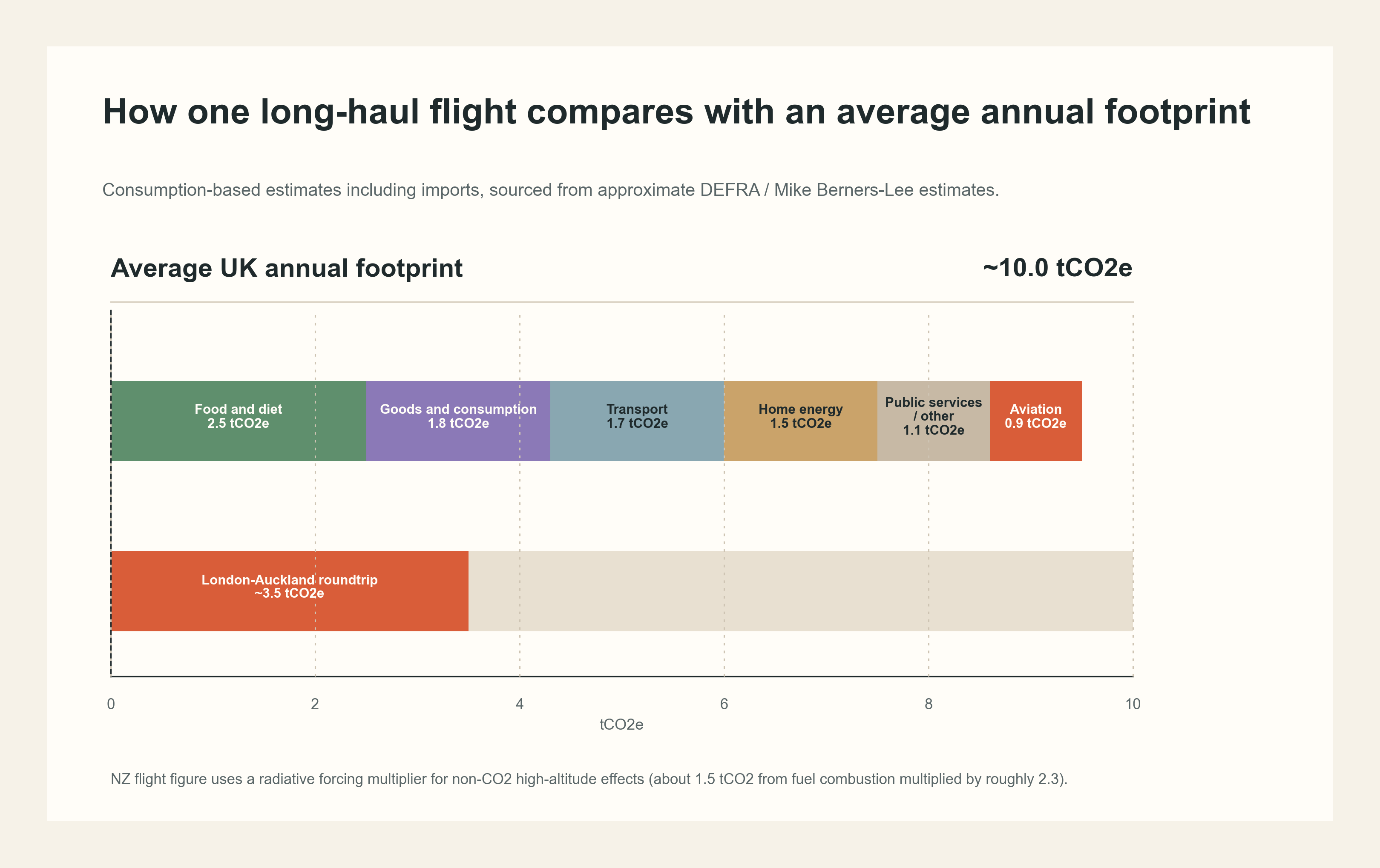
That breaks down roughly as: transport excluding aviation (1.7t), food and diet (2.5t), home energy (1.5t), goods and consumption (1.8t), public services (1.1t), and aviation (0.9t). But that aviation figure is a population average, which includes the roughly half of British adults who take no flights in a given year.
The flying population is not the average population. Around 15% of people account for roughly 70% of all flights. If you fly regularly, particularly long-haul, your aviation footprint is a significant multiple of that 0.9-tonne average.
To make this concrete: a return flight from London to Auckland generates approximately 1.5 tonnes of CO2 per passenger from fuel combustion alone, each way. But the CO2 figure systematically understates the problem. Aircraft emit at high altitude, where water vapour forms contrails that trap outgoing heat, and nitrogen oxides create ozone. The best estimates suggest these non-CO2 effects roughly double or triple the total warming impact. Applying that multiplier, a single London-Auckland return sits somewhere between 3 and 7.5 tonnes of CO2 equivalent. The midpoint is not far off half of an average person’s entire annual footprint.
A single trip home is not a rounding error.
Do Airline Offsets Work?
Most airlines now offer a carbon offset at checkout. The price ranges widely: British Airways charges around £33 for a London-New York economy return, while the UN aviation offset scheme implies as little as €2.40 per passenger on a transatlantic flight. The mechanism is almost always the same. Your money goes to a forestry project, typically a tropical rainforest the scheme claims to be protecting from deforestation. You are told your flight is now carbon neutral.
There are three fundamental problems with this.
The additionality problem. For an offset to be real, the carbon saving must be additional, meaning it must not have happened anyway. A 2023 investigation by The Guardian and others into Verra, the world’s largest carbon credit certifier, found that the vast majority of rainforest credits it had issued were likely “phantom credits” with no real reduction in deforestation. The additionality is assumed rather than demonstrated.
The permanence problem. Even where trees genuinely absorb carbon, forests burn, get diseased, or get cleared when political administrations change. The carbon your flight emitted remains in the atmosphere for a century; the forest you paid to protect may not last a decade.
The non-CO2 problem. Carbon offsets are priced against CO2. They do not touch contrail warming or nitrogen oxide effects. Even a perfectly verified, permanently stored tonne of carbon removal only addresses part of what your ticket actually costs the atmosphere.
But What About Offsets That Actually Work?
Not all offsets are the same. The problems above apply to forestry credits, which is what airlines sell. But there is a category of carbon removal that does not share these problems: direct air capture, where machines pull CO2 from the atmosphere and store it geologically; enhanced rock weathering, which accelerates a natural geological process where certain minerals absorb CO2 as they break down; and bio-oil injection, where agricultural waste is converted and pumped underground. These approaches have genuine permanence.
Companies like Climeworks and Charm Industrial operate in this space. The price reflects the real cost: somewhere between $300 and $600 per tonne of CO2. At that rate, genuinely offsetting a London-Auckland return, accounting for the radiative forcing multiplier, would cost somewhere between £1,000 and £3,000 per passenger. That is not a product anyone is selling at checkout.
More importantly, it is not a product that could ever be. And this is where moral philosophy has something useful to say.
The Universalizability Test
Immanuel Kant’s categorical imperative asks a simple question: could you will the principle behind your action to become a universal law? In plain terms: what if everyone did this?
It is a useful filter for ethical reasoning that quietly depends on most people not participating. The global supply of credible permanent removal credits from direct air capture is currently measured in the tens of thousands of tonnes per year. Global aviation produces roughly a billion tonnes of CO2 annually from fuel combustion alone. If every passenger on every flight attempted to genuinely offset their journey, the market would not accommodate them. The offset system, even at its most credible, is structurally dependent on remaining a niche product.
Scale it up and it either collapses under demand, or the price rises to reflect the real cost of permanent removal, which brings you back to £1,000 per long-haul flight and no airline selling it at checkout.
The universalizability test does not just reveal a market capacity problem. It reveals that offsetting, as a personal ethical strategy, only makes sense if you assume most other people will not do it. That is a strange foundation to build a moral position on.
Are They Net Positive Anyway?
Even accepting all of the above, you might argue cheap offsets are better than nothing. Some real carbon is probably being avoided somewhere. The question is whether that marginal benefit outweighs the psychological cost.
There is a growing body of research on what psychologists call moral licensing: the tendency for a virtuous act to give people permission, consciously or not, to act less virtuously elsewhere. A 2021 controlled study published in Business Strategy and the Environment found that when voluntary carbon offsets were available, the likelihood of people making environmentally harmful consumption choices actually increased. The availability of the offset, not even the purchase of it, was sufficient to shift behaviour.
If you bought the offset at checkout, you have closed the psychological ledger. You are less likely to think carefully about whether you need the next trip, less likely to choose the train for a European journey, less likely to engage with systemic advocacy that might actually move the system. The guilt that should motivate action has been efficiently neutralised for the price of a large coffee.
The product being sold is not matched to the problem being solved. And if it actively reduces the motivation to do things that matter more, it is probably net negative.
So if offsets are not the answer, what is? That is the subject of the next post.