Things Just Work, and a Bit of Chaos
Notes from two weeks in Taiwan: civic order, street-level chaos, and the infrastructure that quietly carries the load.
Read the practical itinerary for this trip: Taiwan Solo, April 2026
April 2026. Notes from two weeks in Taiwan.
I’m two weeks into a clockwise loop of Taiwan and the dominant impression is hard to shake: the place runs. Not in the joyless Swiss sense where everything is efficient and slightly embalmed, but in a way that leaves room for the noise. The trains are on time. The signage is clear. And then you turn a corner and a hundred scooters are weaving through a night market where someone is grilling squid next to a Buddhist temple next to a betel-nut stand.
It took me a while to figure out what I was looking at. The order and the chaos are not in tension. They are different layers of the same city, and the order is what lets the chaos be enjoyable rather than exhausting.
The order
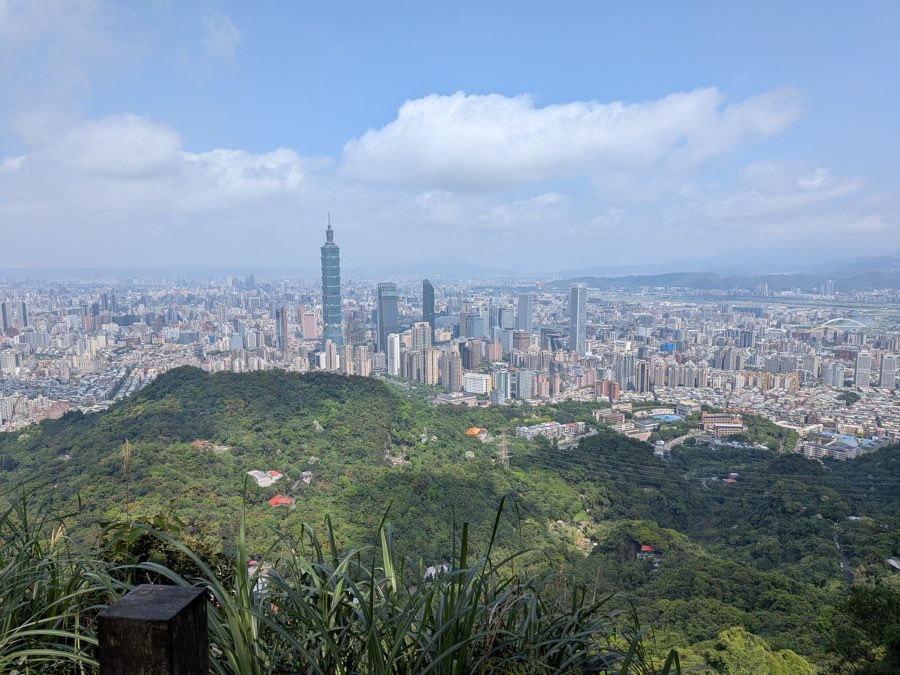
Some of it is infrastructure. The MRT in Taipei is excellent: clean, frequent, signed in clear English, with countdown timers and platform doors. It even gets you to the trailhead of Elephant Mountain, the city’s best-known short hike, one stop past Taipei 101. The high-speed rail is faster and more punctual than anything in the UK. EasyCard works on trains, buses, ferries, parking, and most convenience stores, and you top it up by waving it at a machine. None of this is novel if you have been to Tokyo or Seoul. What is striking is how unobtrusive it all is. You stop noticing it within a day, which is the highest compliment you can pay to civic infrastructure.
Some of it is behavioural, and this matters more than the infrastructure. People queue. They do not jaywalk, even on an empty street late at night. Litter is rare despite the near-total absence of public bins, because everyone takes their rubbish home or to the next 7-Eleven. The bins are mostly missing because rubbish is collected directly: a yellow truck rolls down the street at the same time every evening playing a tinny version of Beethoven’s Für Elise, and people come out of their houses and apartment blocks carrying bags to throw straight in. It looks chaotic the first time you see it, until you realise the entire neighbourhood has the schedule memorised. There is almost no visible homelessness or street drinking. Crime is low enough that locals leave bags on cafe tables to reserve seats while they go to the counter. The order is not enforced, it is participated in.
This second layer, the civic one, is the one that surprised me. Tokyo gets the same effect through density of signage and ritualised politeness. Taipei gets it through something more like collective good faith, and an extraordinary baseline of friendliness. People stop you in the street to help when you look lost. Shopkeepers walk you to the right bus stop. You can drop in not speaking a word of Mandarin and be oriented within hours, because the people are the legible part.
The 7-Eleven as state
A small thing that becomes a big thing once you see it. Convenience stores in Taiwan are not what the word means in the UK or the US. They are extensions of the public infrastructure: bill payment, package pickup, ticket purchase, ATM, hot food, free aircon, working toilets, and increasingly delivery hubs and pharmacy windows. There is a 7-Eleven or FamilyMart roughly every 200 metres in central Taipei. Taiwan has the highest convenience store density per capita in the world, around one store per 2,000 people, and Taipei is denser still.
I caught myself doing the math the other day. I saw a 7-Eleven on the far side of a six-lane intersection, weighed crossing the road against the heat, and thought: I will just see one on this side soon. I did, within ninety seconds. The infrastructure is so reliable that it changes how you walk through the city. You stop carrying water. You stop planning meals. You stop worrying about cash, change, train tickets, package delivery, or finding a toilet. The store does the planning for you.
It is also a quiet redistributive function. A 7-Eleven is a heated, air-conditioned, well-lit, and bathroom-equipped public space that anyone can use without buying anything. In a country where the summer hits 38 degrees and typhoons arrive without much warning, that matters. The UK has nothing like it. The closest equivalent is probably a public library, except libraries close.
The chaos
Now to the other layer. None of the above is what you remember at the end of a day. What you remember is the scooter swarm at the lights, fifty deep, revving in synchrony before lurching forward together. The night market at Raohe at 9pm, smoke rising from a hundred stalls, a man boning a whole fish in eight seconds flat. The lanes (巷, xiàng) running off every main road, narrow and crooked, full of tiny restaurants and altars and laundry strung between balconies. The betel-nut stands lit up in fluorescent pink. Cash everywhere at the markets and small vendors, even though the cards work fine in the chains.
The chaos is commercial and street-level. It is texture, not disorder. Watch the scooters for ten minutes and you start to see the rules: how they fill the box at intersections, how they signal, how the left-turn waiting zone works. Watch the night market and the system reveals itself: which stalls are for tourists, which for locals, who pays first, who points. The illegibility is on the surface. Underneath, everything is running on a tight code.
Some of the chaos is also a choice. Taiwan could have gone the way of South Korea or Singapore and sanded off the informal layer in the name of progress. Instead the night markets and traditional markets persist, the small vendors stay cash-heavy, the lanes survive redevelopment, and old women still sell betel nuts from converted shipping containers next to the metro. The country has the planning competence to bulldoze and has mostly chosen not to. That is a more interesting fact about Taiwan than any single observation about scooters.
Why it works
I think the answer is that the two layers do different jobs. The infrastructure handles the things you do not want to think about: getting somewhere, paying for something, finding a toilet, seeing a doctor. Taiwan’s healthcare system is cheap, simple to use, and built around a single National Health Insurance card. The street layer handles the things you do want to think about: what to eat, who to talk to, what catches your eye. The first layer is uniform and reliable. The second is varied and surprising. Neither would work without the other.
Most cities collapse this. London tries to make the street layer interesting by making the infrastructure layer stylish, and ends up with both inconsistent. Singapore makes the infrastructure pristine and the street layer disappears with it. American suburbs solve neither. Tokyo gets close to the Taiwan model but pushes the infrastructure so far that the city tips slightly into the polished. Taipei’s infrastructure is excellent without being showy, which leaves the street layer room to breathe.
The thesis sentence, if I had to write one: Taipei is a rare city where the system is strong enough to disappear, leaving you alone with the street.
I am writing this on the Alishan Forest Railway, a charming, slow, and very bumpy narrow-gauge train that climbs up through bamboo and cedar from the foothills into the mountains. The carriage is rocking enough that my handwriting is illegible. Out the window the forest drops away into fog, then opens up onto tea terraces, then closes again. The train will take three hours to do what a road would do in ninety minutes. Nobody on board seems to mind.