Why are children staying in nappies so much longer?
Children in wealthy countries toilet train much later than they used to, and biology alone does not explain the shift. Gentler parenting norms and increasingly convenient disposable nappies seem to have reinforced each other.

My sister told me something that initially sounded like one of those dubious parenting statistics that circulates forever because nobody checks it. Children used to be potty trained much earlier. The exact internet version is often too neat. Claims such as “90% of children were trained by 18 months in the 1950s” are hard to substantiate cleanly.
But the underlying story is real. American toilet training shifted substantially later during the second half of the twentieth century. And the reasons seem to involve a strange interaction between paediatric advice, technology and changing expectations of childhood.
The historical shift is real
The data are not perfect. Different studies used different definitions of “toilet trained”, different populations and different methods. So this is not a neat national time series. But the direction is remarkably consistent.
A useful comparison comes from a 1984 paper by John Martin and colleagues, which followed 71 American children and compared them with an earlier 1947 cohort. In 1947, about 60% of children were trained by 18 months and around 95% by 33 months. In the later cohort, only around 2% were trained by 18 months and about 59% by 33 months. Other studies point in the same direction.
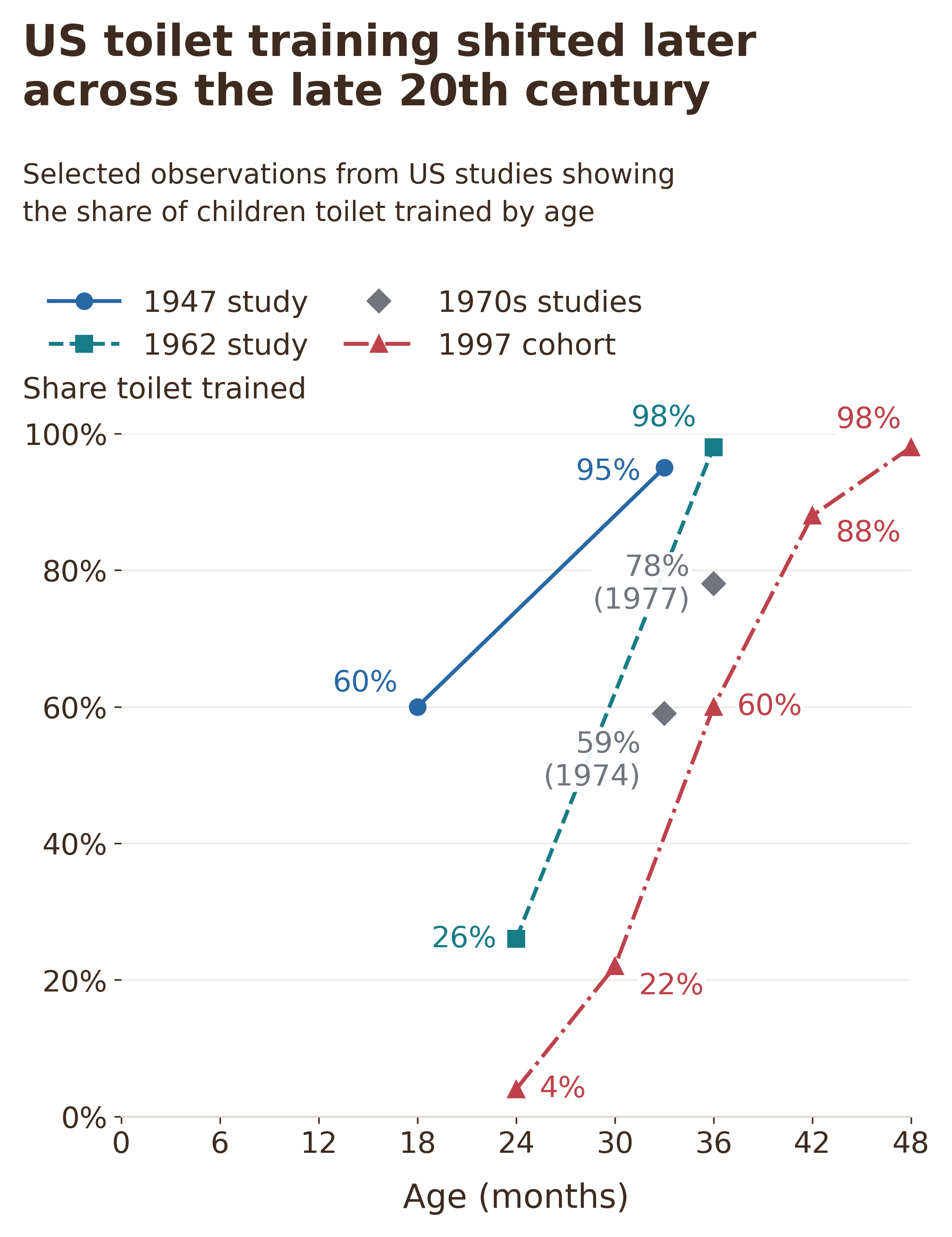
The late-1990s evidence gives another useful snapshot. Bruce Taubman’s 1997 study followed 482 children in a private suburban paediatric practice serving predominantly middle- and upper-middle-class families. Around 60% were trained by 36 months. About 2% were still untrained at 48 months. That is not nationally representative, but compared with the earlier studies, the direction is clear.
Recent UK evidence is messier still, but school surveys suggest late toilet independence is now common enough to be visible at school entry. In a survey of the September 2025 Reception cohort, primary-school staff estimated that about 26% of children were having frequent toilet accidents. That is not a clinical measure, and teachers are estimating rather than reporting an administrative count. Still, one child in four is striking.
Children themselves presumably have not changed very much over seventy years. So what did?
The parenting advice changed first
One part of the story predates disposable nappies. Early twentieth-century toilet training could be strict and coercive. Mid-century paediatricians increasingly pushed back against that. The most famous was T. Berry Brazelton. His child-oriented approach emphasised waiting for signs of physiological and psychological readiness rather than imposing a rigid schedule.
There is an important wrinkle here. Brazelton’s 1962 study is sometimes quoted as though it simply measured when American children naturally toilet trained. It did not. Parents in his practice were following his method. In his cohort of 1,170 children, 26% were trained by 24 months, 52% by 27 months, 85% by 30 months and 98% by 36 months. Those numbers show what happened under an explicitly child-led approach.
That was in many ways an improvement. Avoiding coercive battles with toddlers seems preferable to the more rigid methods that preceded it. But over time, two propositions seem to have become blurred: “Do not force a child” and “Do not begin until the child spontaneously demonstrates readiness”. Those are not the same thing.
Starting conventional training earlier does not necessarily help
This is also where the evidence gets more subtle than “earlier is better”. One prospective study found that starting intensive toilet training before 27 months tended to make the training process last longer. Within that early-starting group, beginning earlier did not reliably lead to earlier completion.
So simply taking modern toddler potty training and moving it six months earlier is not obviously useful. That matters because it distinguishes two very different things:
- conventional toilet training begun earlier;
- assisted toileting from infancy.
The Vietnamese evidence falls into the second category.
Then nappies became extremely good
While paediatric advice was changing, the product itself was changing too. Modern disposable nappies are an impressive piece of engineering. They wick moisture away from the skin, absorb large amounts of liquid and remain comfortable for hours. That makes life easier for parents and children.
It may also reduce one of the incentives to stop using them. A wet cloth nappy gives fairly immediate feedback. A modern disposable is specifically designed not to.
So by the second half of the twentieth century, two things were happening together. Parents were increasingly being told not to hurry. And the practical cost of waiting was getting much smaller.
The Brazelton-Pampers footnote
There is an almost suspiciously neat coda to this history. Brazelton’s child-led ideas long predated any commercial relationship with Pampers. But decades later, he became chairman of Procter & Gamble’s Pampers Parenting Institute. And when Pampers introduced a larger size 6 nappy for bigger toddlers in the late 1990s, Brazelton appeared in advertising encouraging parents not to rush toilet training.
That does not mean Pampers invented child-led toilet training. Brazelton had been advocating the approach for decades.
But the alignment of incentives is hard to miss. A parenting philosophy said there was no need to hurry. A product made waiting much easier. Eventually, the paediatrician most associated with that philosophy was helping advertise larger versions of the product. That is less a conspiracy than a feedback loop.
What other countries show
The clearest evidence that today’s Western timetable is not biologically fixed comes from cross-cultural comparisons. The Vietnamese study I mentioned in the previous post is particularly striking.
Among 47 Vietnamese children, 89% were being offered the potty daily by six months. By two years, 98% had completed potty training. Among 57 Swedish children studied in a comparable way, only 5% had even begun daily potty training by age two.
The Vietnamese children were not independently “toilet trained” as babies in the way we would describe an older child. The process was assisted. Parents learned timing and signals, offered the potty regularly and sometimes used a whistling sound as a cue. That is essentially elimination communication.
The physiology was interesting too. Researchers reported complete bladder emptying in the Vietnamese group by nine months, compared with 36 months in the Swedish group. That does not prove that early assisted toileting improves long-term health. The study was small and observational. But it does make it hard to argue that children simply cannot participate in toileting before the age at which Western families now tend to begin.
Is later toilet training bad?
The health evidence is not clean enough for a strong answer. One case-control study found that children with urge incontinence had started toilet training later on average than control children, roughly 31.7 months versus 28.7 months. That could mean later training contributes to bladder problems. It could also mean children predisposed to bladder problems are simply harder to train. Observational studies cannot easily separate those explanations.
Likewise, the Vietnamese bladder-emptying findings are interesting without proving that Western children suffer harm from later training. On the other side, the evidence does not suggest that simply pushing conventional toilet training earlier is automatically beneficial either. So I would not conclude that “early is healthier”.
The more defensible conclusion is narrower. The Western timetable is not biologically inevitable. Assisted toileting can begin much earlier. And waiting until age two or three before introducing any form of toileting is a cultural norm, not a hard developmental law.
So why did the timetable move?
I do not think there is one cause. Paediatric advice changed. Disposable nappies improved. Women’s employment changed. Childcare changed. Washing technology changed. Family routines changed. And expectations around autonomy and readiness changed.
But there is a particularly neat interaction between the first two. Child-led paediatrics reduced the pressure to start early. Disposable nappies reduced the inconvenience of waiting. Together, those changes made later toilet training easier and more socially normal. The technology and the norm reinforced one another. And over time, something historically uncommon began to feel completely natural.
None of this tells an individual parent when they should toilet train their child. It does suggest that the age at which children leave nappies is less biologically fixed than we tend to assume. And that, to me, is the more interesting story.